BetterReads Blog
Epic Chapter Lens: Line-by-Line Help for Homer
By Zhao Lu ·
See also: Stage Lens — how BetterReads handles plays and dramatic beats.
Epic poetry moves differently from prose
The Odyssey does not begin with a character walking into a room.
It begins with an invocation—Sing, O Muse—and a pan across ten years of war and wandering before the narrative settles on Ithaca. Names pile up (Atlas, Calypso, the Phaeacians). The gods meet on Olympus. Athena plans a disguise.
If you are reading Butler's prose translation, some of that is manageable. If you are reading verse—or simply reading Homer for the first time—the difficulty is not only vocabulary. It is pace: epithets, repeated formulas, divine machinery, and a narrator who assumes you already know Troy fell.
A standard chapter summary helps at the end. It does not help on the line you are stuck on.
BetterReads uses an Epic Chapter Lens for verse epics: a companion that combines book-level framing with scroll-synced line helps tied to your place in the text.
Right now, the full Epic Chapter Lens is available on one title: the Odyssey. We are still improving the content and the reading experience—making hard lines easier to digest, tightening what appears on screen, and learning from real reading sessions—before we expand the same approach to other long poems and epics.
What Epic Chapter Lens includes
Each book of the epic opens a lens with sections tuned to how these poems actually work:
- On this page — where you are inside the book's opening movement (invocation, divine council, first scene on earth)
- Lines you're reading — quoted phrases from the text with short plain-language glosses, updating as you scroll
- What is happening — the narrative thread at this stage of the book
- What is difficult here — syntax, myth references, or conventions that trip modern readers
- What should I notice — images, repetitions, or turns worth carrying forward
- Background — optional myth and audience context (expand when you need it)
- Who's in this chapter — divine and mortal figures active in this book
For the Odyssey, a Before you read guide is also available from the lens—useful for names, geography, and the poem's oral habits before you enter Book I.
Example: Book I of the Odyssey
Book I is often where readers decide whether Homer is for them.
In outline: the Muse is asked to sing; we hear that Odysseus is detained by Calypso while suitors consume his house; on Olympus Athena argues for his release; she descends to Ithaca disguised as Mentes and speaks with Telemachus, urging him to call an assembly and seek news of his father.
The plot is clear in retrospect. On first read, the difficulty is local:
- Who is speaking in the invocation, and to whom?
- Why does the narrative jump from Olympus to Ithaca without warning?
- What does Telemachus know, and what has he only guessed?
Epic Chapter Lens keeps those questions anchored to the lines in view. Near the opening, you might see help for the Muse's call and the summary of Odysseus's wanderings. Farther down, help shifts toward Athena's plan and Telemachus's situation—because the lens follows scroll position, not a fixed sidebar written for the whole book at once.
Scroll-synced line helps
The most distinctive part of Epic Chapter Lens is Lines you're reading.
Each help pairs a short quote from the passage with a one- or two-sentence gloss—not a lecture, not a replacement for the text. As you move through the book, helps near the top of the page surface and retire; if more helps exist farther along, the panel tells you to keep scrolling.
That design matches how epics were experienced: in motion, line by line, with repeated formulas that reward patience rather than a single upfront summary.
It also keeps the companion honest. Epic Chapter Lens does not pretend to explain every line in the book at once. It stops at what the text has actually shown you so far.
Epic Lens vs Chapter Lens vs Stage Lens
BetterReads chooses a companion shape to match the text:
| Text | Lens | Why |
|---|---|---|
| Novels (Dracula, Middlemarch) | Chapter Lens | One narrative unit → summary, themes, characters |
| Plays (Agamemnon, Shakespeare scenes) | Stage Lens | Dramatic beats, stage picture, argument — read more |
| Verse epics (Odyssey today) | Epic Chapter Lens | Book-scale arc + line-level difficulty |
Agamemnon is the Stage Lens flagship; the Odyssey is the Epic Chapter Lens flagship—one book each, for now, while we improve and expand.
Where we are—and where this is going
Epic Chapter Lens is not finished work. We are still:
- Refining line helps — clearer glosses, better pacing, fewer words between you and the poem
- Improving book-level framing — what belongs in "what is happening" vs "what is difficult" vs optional background
- Expanding to more poems — Homer first; other verse epics and long-form poetry as the format stabilizes
Other Homeric editions or translations in the catalog may use the standard Chapter Lens until Epic Chapter Lens reaches them. The aim is not to annotate every line in every classic—it is to make the hardest forms readable without breaking the spell of the text.
When to open Epic Chapter Lens
Reach for it when:
- a proper name or epithet stops you and you do not want to break reading to search
- you are re-entering after a break and need "where am I in this book?" not a spoiler for Book V
- you are teaching yourself Homer and want structure without Cliff Notes tone
- you are reading on web or tablet and want the companion beside the text (Focus mode is still there when you want silence)
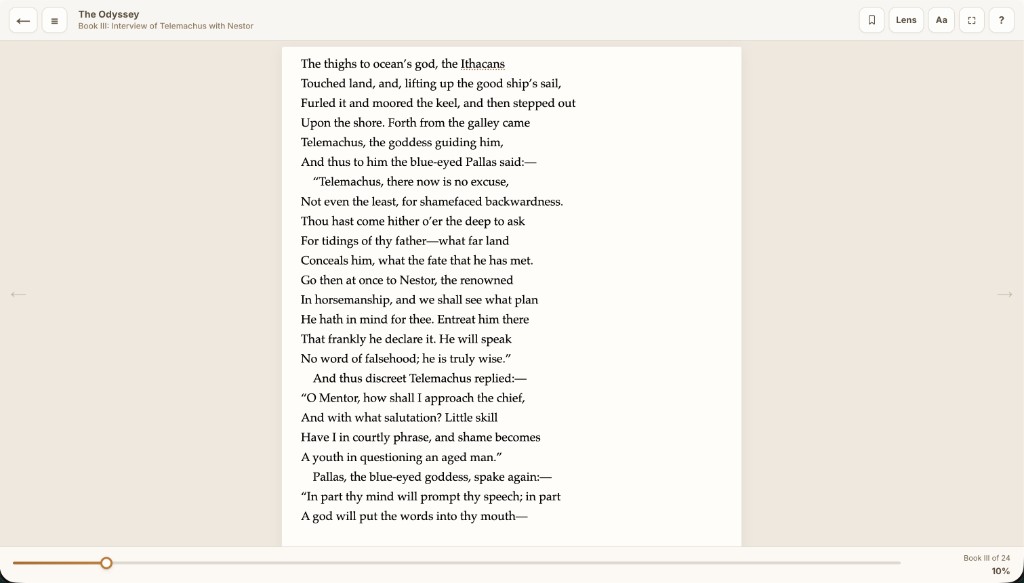
Open the reading companion from the toolbar (or press A in the web reader). The label reads Epic Chapter Lens when the book supports it.
Reading epics as epics
Homer's poems were composed for listening. BetterReads will not recreate the sound of hexameter or the presence of a rhapsode.
What Epic Chapter Lens can do is respect the granularity of the form: the line that needs a gloss, the book that needs a frame, the myth the audience was expected to share. Read the poem. When a line resists you, the lens meets you there—and stays out of the way when it does not.
Try it: Open the Odyssey in BetterReads, go to Book I, and open the reading companion beside Telemachus's first scene.
Get BetterReads on your phone
Your bookshelf, highlights, and reading tools are in the iOS and Android apps—the same experience as the web reader, synced when you sign in.
Or continue in the browser at betterreads.online.