BetterReads Blog
Structured Annotation for Deep Reading
By BetterReads ·
Why Structured Annotations Help Readers Remember Books
A cognitive approach to reading classic literature
Introduction
Many readers share the same experience after finishing a book:
“I remember that I enjoyed it, but I can barely recall what actually happened.”
This difficulty becomes particularly noticeable with complex literature such as Dostoevsky, Tolstoy, or Dickens. These works often contain dense philosophical ideas, large casts of characters, and intricate narrative structures. Readers may follow the story while reading, yet weeks later struggle to recall the themes, events, or character motivations.
Most reading applications attempt to address this problem through highlighting and note-taking. While useful, these tools often produce long lists of isolated passages that are difficult to interpret when revisited later.
Research in cognitive psychology suggests that the problem is not simply whether readers take notes, but how information is structured during learning. Memory retrieval becomes significantly easier when knowledge is organized into meaningful conceptual categories rather than stored as unstructured fragments [1, 2].
This insight motivates the idea of structured annotation.
The Limits of Traditional Highlights
Most digital reading platforms allow readers to highlight text and optionally attach notes. However, traditional highlighting has several limitations.
First, highlights typically lack semantic structure. A highlighted sentence might represent a vocabulary definition, a plot event, or a philosophical idea, but the system records them all in the same way.
Second, highlights often lose their narrative context. When readers return to them weeks or months later, it can be difficult to remember where the passage appeared in the story.
Finally, large collections of highlights can create cognitive overload. Without a meaningful structure, the reader must mentally reconstruct the context of each passage, which makes review inefficient.
In effect, conventional highlighting stores text fragments rather than organized knowledge.
Structured Annotation: Adding Meaning to Highlights
Structured annotation introduces a simple idea: when highlighting a passage, the reader also assigns a semantic category to the annotation.
Instead of treating all highlights equally, passages can be labeled according to their role in the text. For example:
- Scene — an important plot event
- Character Insight — psychological information about a character
- Theme — a philosophical or conceptual idea
- Quote — a memorable line
- Glossary — a definition of an unfamiliar word
This approach turns highlighting into a form of active interpretation rather than passive marking.
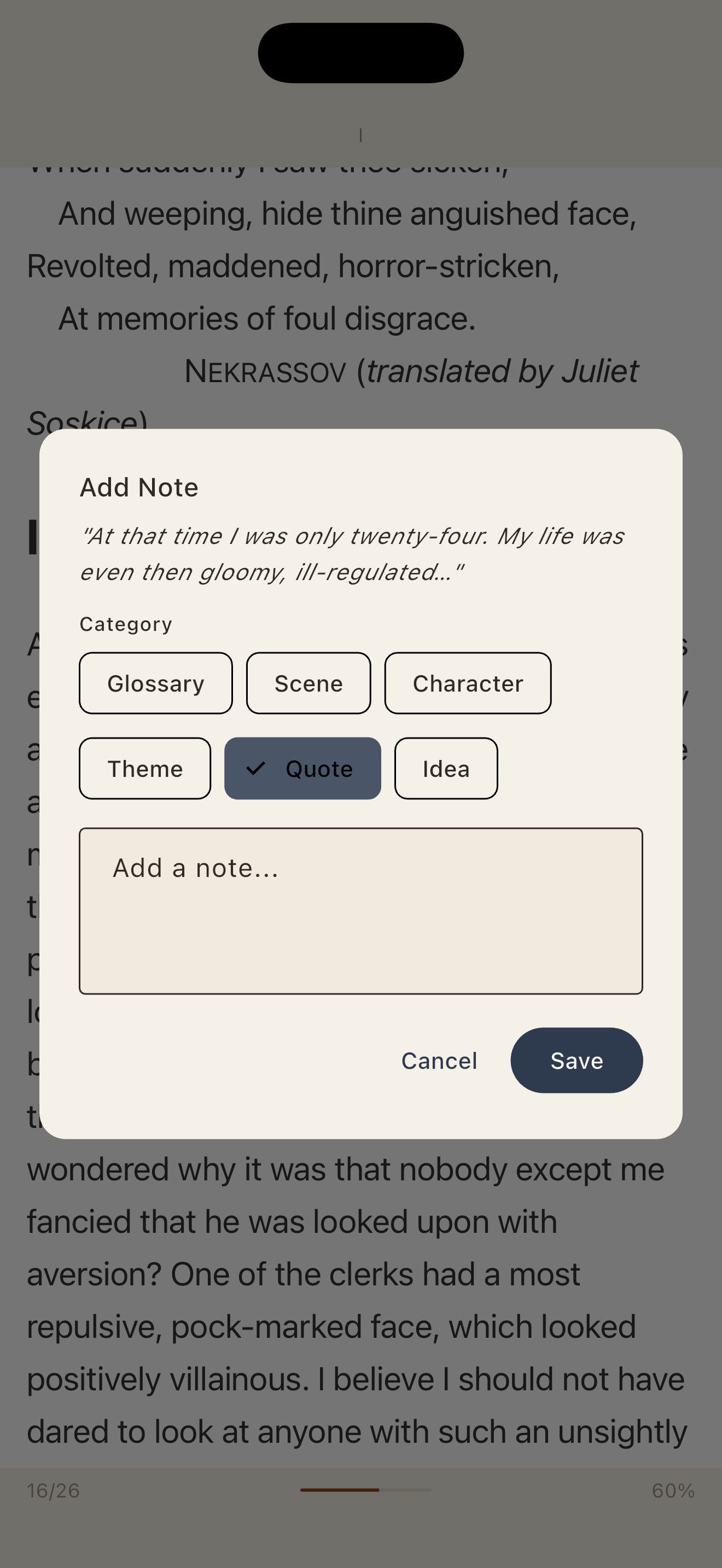
For instance, while reading Notes from Underground, a reader might annotate a passage in the following way:
Scene
The officer silently pushes the narrator aside on the street.
Character Insight
The narrator cannot tolerate being ignored; humiliation comes from invisibility.
Theme
Human beings sometimes act irrationally simply to prove their freedom.
Each annotation captures a different layer of meaning in the text.
Why Structured Notes Improve Memory
The effectiveness of structured annotations can be understood through several well-established principles in cognitive science.
Active Recall
Active recall refers to the process of retrieving information from memory rather than passively reviewing it. Learning improves when readers actively engage with the material during encoding [3].
Assigning a semantic category to a passage requires readers to interpret its meaning, which strengthens the encoding process.
Elaborative Encoding
Elaborative encoding occurs when new information is connected to existing knowledge structures. Generating explanations or interpretations during study significantly improves comprehension and retention [4].
Labeling a passage as a theme or character insight forces the reader to interpret its role in the broader narrative.
Schema-Based Learning
Schemas are mental structures that organize knowledge into meaningful categories. According to schema theory, information that fits within an existing conceptual framework is easier to store and retrieve [1].
By organizing annotations into categories such as characters, themes, and scenes, readers gradually construct a schema of the book.
Desirable Difficulties
Learning can also benefit from moderate cognitive effort. Tasks that require interpretation or retrieval may feel harder initially but lead to stronger long-term retention [5].
Structured annotation introduces exactly this type of productive effort.
Reconstructing a Book Through Annotations
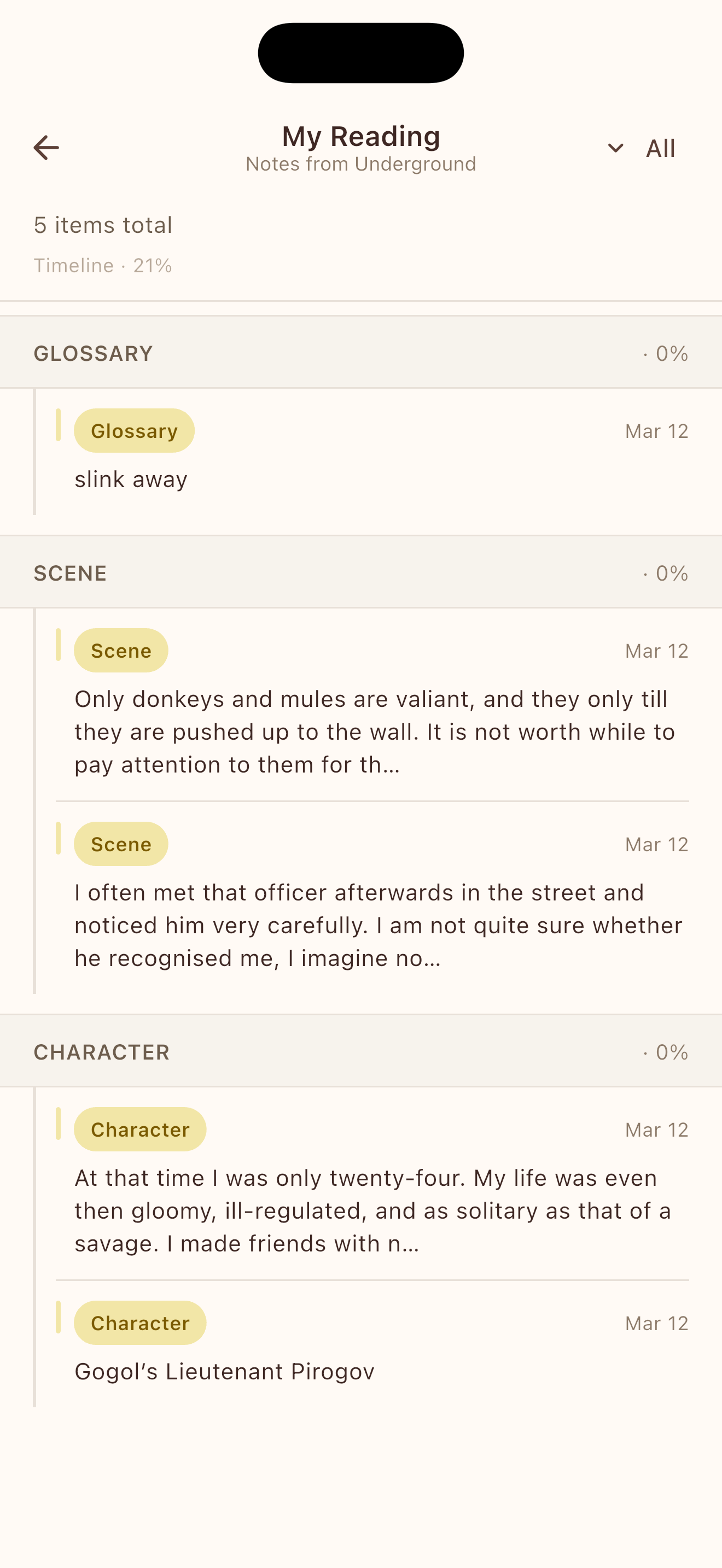
When annotations are organized by category, reviewing them becomes far more meaningful.
Instead of browsing a chronological list of highlights, readers can revisit the book through different conceptual perspectives.
For example:
Themes
- Freedom versus rational self-interest
- Pride and humiliation
- Recognition and invisibility
Characters
- The Underground Man: hypersensitive, self-conscious, deeply resentful.
Scenes
- The officer encounter
- The dinner with former schoolmates
- The meeting with Liza
Even months after finishing the book, a brief review of these annotations can quickly restore the reader’s understanding of the narrative and its ideas.
Implications for Reading Tools
Most digital reading platforms were originally designed for convenience: portability, search, and bookmarking. However, the next generation of reading tools may increasingly focus on learning and retention.
Structured annotations represent one step in this direction. Instead of merely storing passages, reading software can help readers organize their understanding while they read.
The goal is not to turn reading into a purely academic exercise. Rather, it is to help readers retain the intellectual and emotional impact of a book long after they finish it.
Conclusion
Great literature often rewards slow and thoughtful reading. Yet the insights gained from a book can fade quickly if they are not organized in memory.
Structured annotations offer a practical way to transform reading into a process of knowledge construction. By categorizing highlights into meaningful concepts such as scenes, characters, themes, and ideas, readers can build a lasting mental model of the text.
In this sense, annotation is not merely a way of marking passages. It becomes a method for thinking with the book itself.
References
[1] Rumelhart, D. E. (1980). Schemata: The building blocks of cognition. In Theoretical Issues in Reading Comprehension.
[2] Anderson, J. R. (1995). Learning and Memory: An Integrated Approach. New York: Wiley.
[3] Karpicke, J. D., & Blunt, J. R. (2011). Retrieval practice produces more learning than elaborative studying with concept mapping. Science, 331(6018), 772–775.
[4] Chi, M. T. H., Bassok, M., Lewis, M. W., Reimann, P., & Glaser, R. (1989). Self-explanations: How students study and use examples in learning to solve problems. Cognitive Science, 13(2), 145–182.
[5] Bjork, R. A., & Bjork, E. L. (2011). Making things hard on yourself, but in a good way: Creating desirable difficulties to enhance learning. Psychology and the Real World.
Get BetterReads on your phone
Your bookshelf, highlights, and reading tools are in the iOS and Android apps—the same experience as the web reader, synced when you sign in.
Or continue in the browser at betterreads.online.