BetterReads Blog
Reading Pathways: How to Read Classics Without Getting Lost
By BetterReads ·
Update (March 2026): For a walkthrough of every pathway in the app—titles, order, and why each arc was built—see Reading Pathways: The Full Catalog.
Most people don’t struggle with reading—they struggle with direction
A large catalog of classics sounds like freedom.
In practice, it often feels like standing in front of an endless shelf: you scroll, hesitate, and close the app.
The real problem isn’t finishing a book. It’s knowing what to read next—and why it matters.
Reading one book in isolation can feel complete. But it rarely feels like progress.
Reading isn’t linear. It’s a pathway.
Great books don’t exist alone. They respond to each other.
- Notes from Underground explores withdrawal and self-consciousness
- Bartleby, the Scrivener turns refusal into quiet resistance
- Crime and Punishment pushes the same questions into action and consequence
Seen separately, they are just books.
Seen together, they form a path of ideas.
That’s what we mean by a Reading Pathway: a small, curated sequence of books that builds toward something.
Not just what to read—but where it takes you.
Why we built Reading Pathways
1. To remove decision fatigue
Too many choices don’t create freedom—they create friction. In controlled studies, people are sometimes less likely to choose at all when the set of options is very large, and can feel less satisfied with what they pick [1]. A meta-analysis of many such studies shows that overload is especially likely when the decision feels complex or your preferences are unclear [2]—which matches browsing a huge catalog of classics you have not read yet.
Instead of choosing from hundreds of titles,
you follow a single thread:
Start here → then go here → then here
One decision replaces dozens.
2. To make connections visible
Classics are in conversation with each other.
But most readers never see that structure.
In literacy education, text sets—groups of texts chosen around a topic or question—are used to build background knowledge and help readers see how ideas carry across readings [3]. A pathway does something similar for voluntary reading: it makes the conversation between books visible before you start.
A pathway makes it explicit:
- why these books belong together
- what each one adds
- how the ideas evolve
You’re no longer guessing the connections—you’re moving through them.
3. To give reading a sense of progress
Finishing a book is satisfying.
Finishing a sequence with a clear purpose is different.
It feels like you’ve completed a unit of thought.
- 2 / 4 completed
- Next: Crime and Punishment
Reading becomes something you can continue, not restart.
4. To support both new and experienced readers
If you’re new, a pathway is a gentle structure.
If you’ve already read some classics,
it becomes a map—showing where you are and what connects next.
You don’t start over. You pick up where the ideas continue.
How it works in BetterReads
On Discover, pathways appear as curated sequences: a theme, an ordered row of books, and your progress.
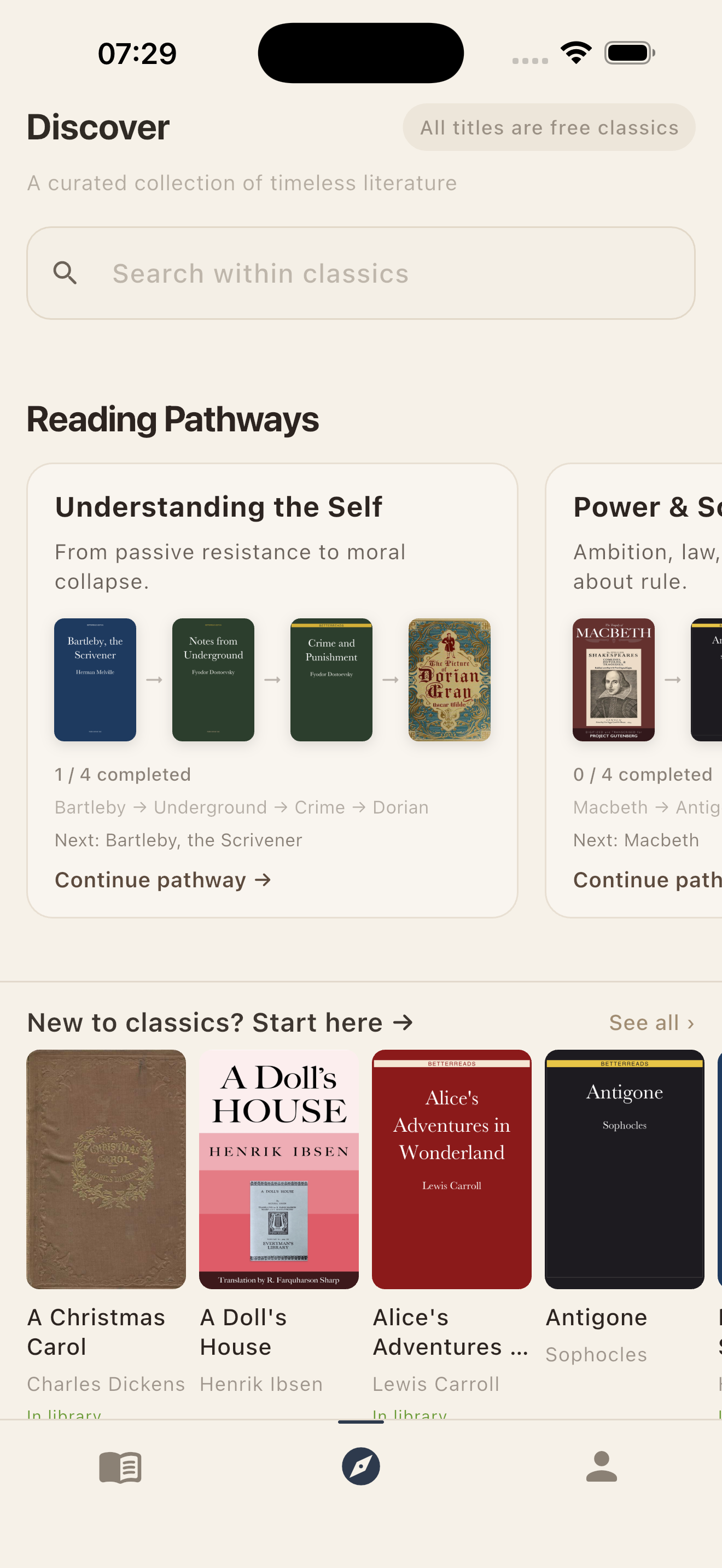
Open a pathway to see the full journey:
- books in order
- a short idea for each step
- your current position
- a clear next move
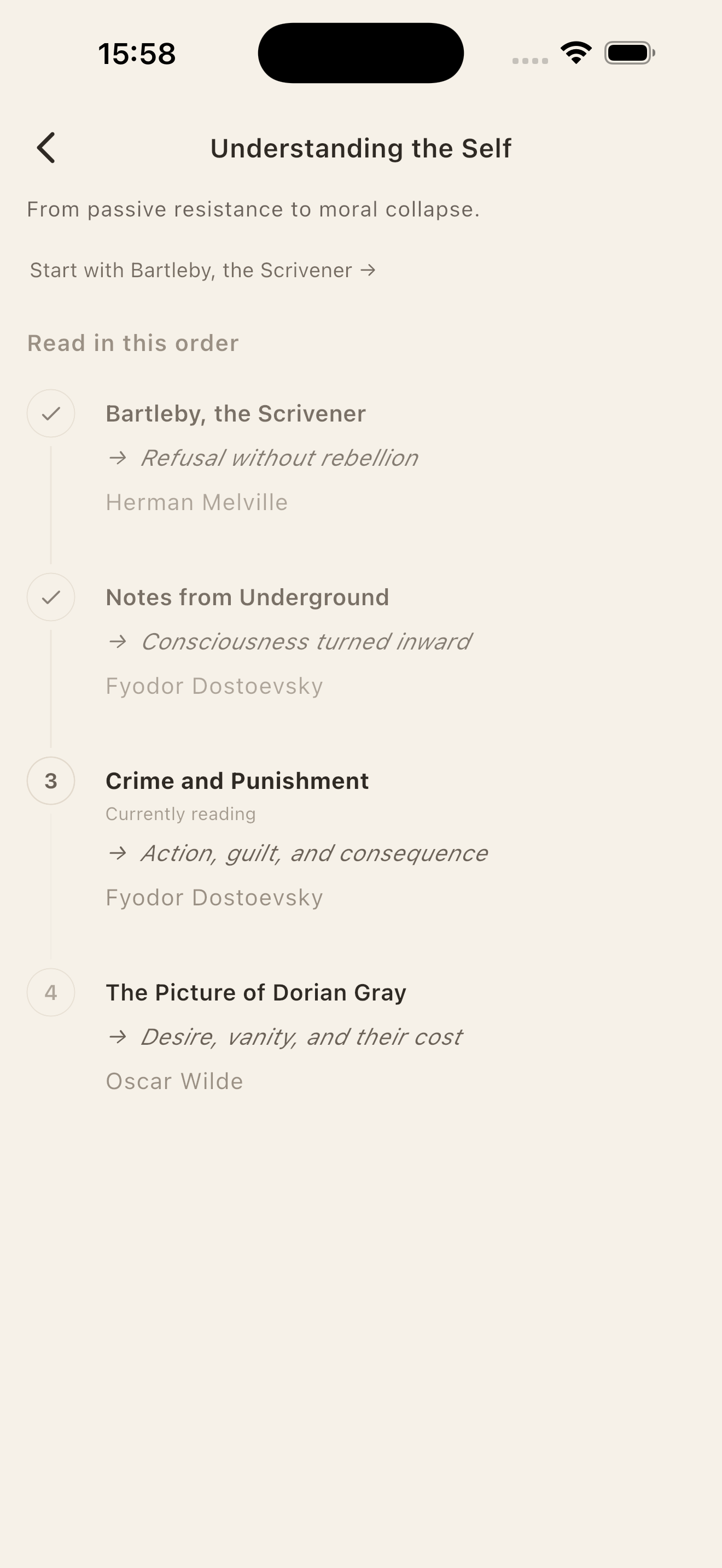
The app shifts from a catalog to something closer to a guide.
This isn’t about limiting choice
You can still explore freely.
Reading Pathways are optional.
They exist for a specific moment: when you don’t just want to read something—
you want your reading to go somewhere.
If you’ve ever felt stuck choosing your next book
That feeling isn’t a lack of discipline.
It’s a lack of structure.
Reading Pathways are a simple fix:
a way to keep moving, stay engaged,
and build something across multiple books.
See also: Reading Pathways: The Full Catalog—every pathway, book order, and editorial rationale.
References
[1] Iyengar, S. S., & Lepper, M. R. (2000). When choice is demotivating: Can one desire too much of a good thing? Journal of Personality and Social Psychology, 79(6), 995–1006.
[2] Chernev, A., Böckenholt, U., & Goodman, J. (2015). Choice overload: A conceptual review and meta-analysis. Journal of Consumer Psychology, 25(2), 333–358.
[3] Lupo, S. M., Strong, J. Z., Lewis, W., Walpole, S., & McKenna, M. C. (2018). Building background knowledge through reading: Rethinking text sets. Journal of Adolescent & Adult Literacy, 61(4), 433–444.
Get BetterReads on your phone
Your bookshelf, highlights, and reading tools are in the iOS and Android apps—the same experience as the web reader, synced when you sign in.
Or continue in the browser at betterreads.online.