BetterReads Blog
Your Highlights Deserve a Second Life: Introducing BetterReads Study
By Zhao Lu ·
Saving a passage is only the beginning
Most reading tools are good at helping you collect things. You highlight a sentence, define an unfamiliar word, write a note, and move on.
Then the collection quietly becomes an archive.
The problem is not that the material has been lost. It is that recognizing an old highlight is not the same as being able to recall the idea. Rereading can feel fluent even when very little has stayed with us.
BetterReads Study was built to close that gap. It brings your companion glossary, personal glossary, notes, and semantic annotations into one calm place—and turns the material you care about into short reviews over time.
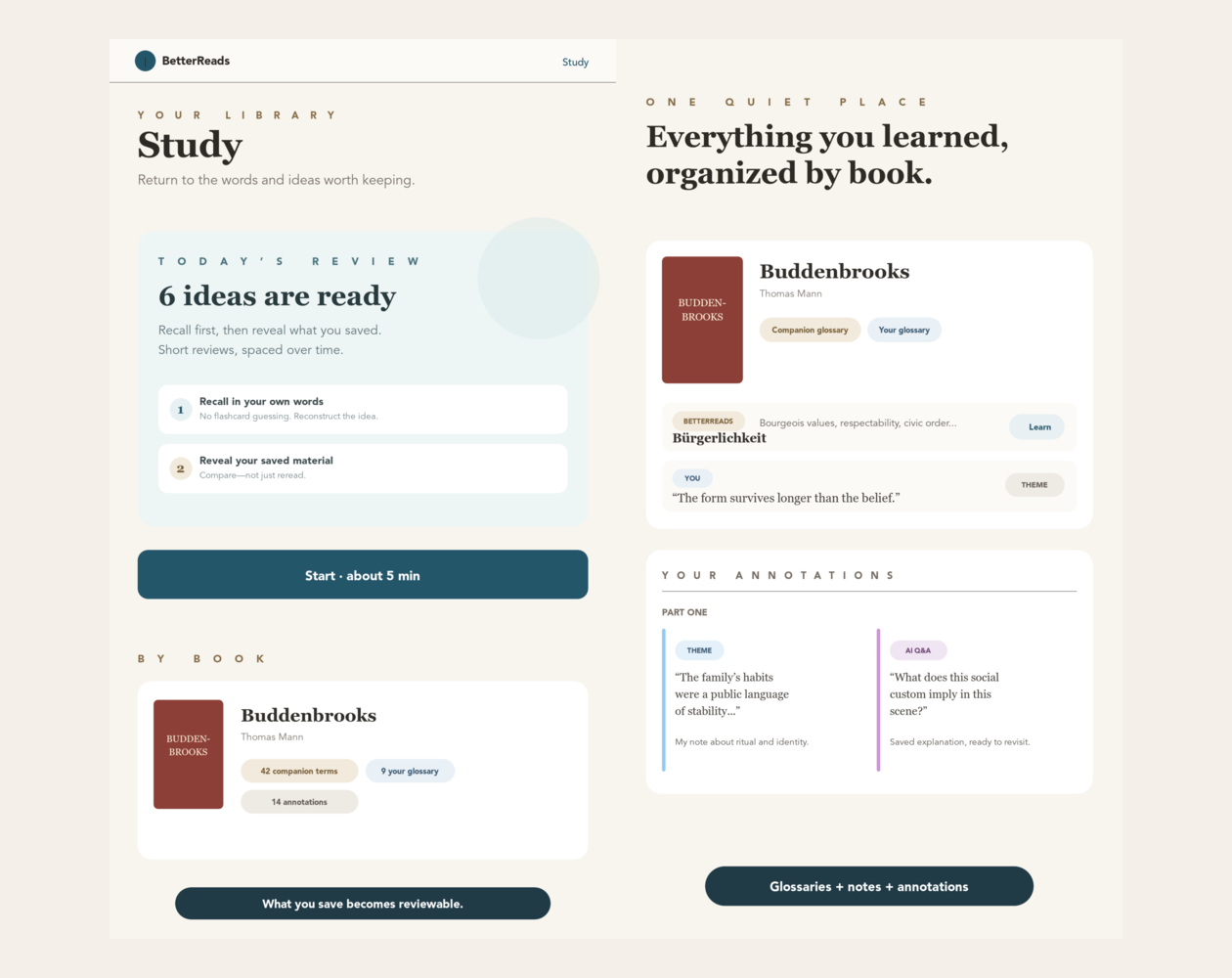
Everything you learned, organized by book
Each book now has a dedicated Study area. Instead of searching across separate highlight, glossary, and notes screens, you can see the full record of your reading together:
- Companion glossary terms curated for the book
- Your glossary entries created while reading
- Notes and annotations grouped by chapter and category
- Saved AI explanations that were useful enough to keep
The two glossaries belong in the same view. A curated definition can supply historical or literary context; your own definition records what you needed to understand in that moment. Seeing both makes the archive more useful without confusing their provenance.
Companion terms do not automatically become homework. Tap Learn only on the terms you want to remember, and BetterReads will add them to future reviews.
Recall first, reveal second
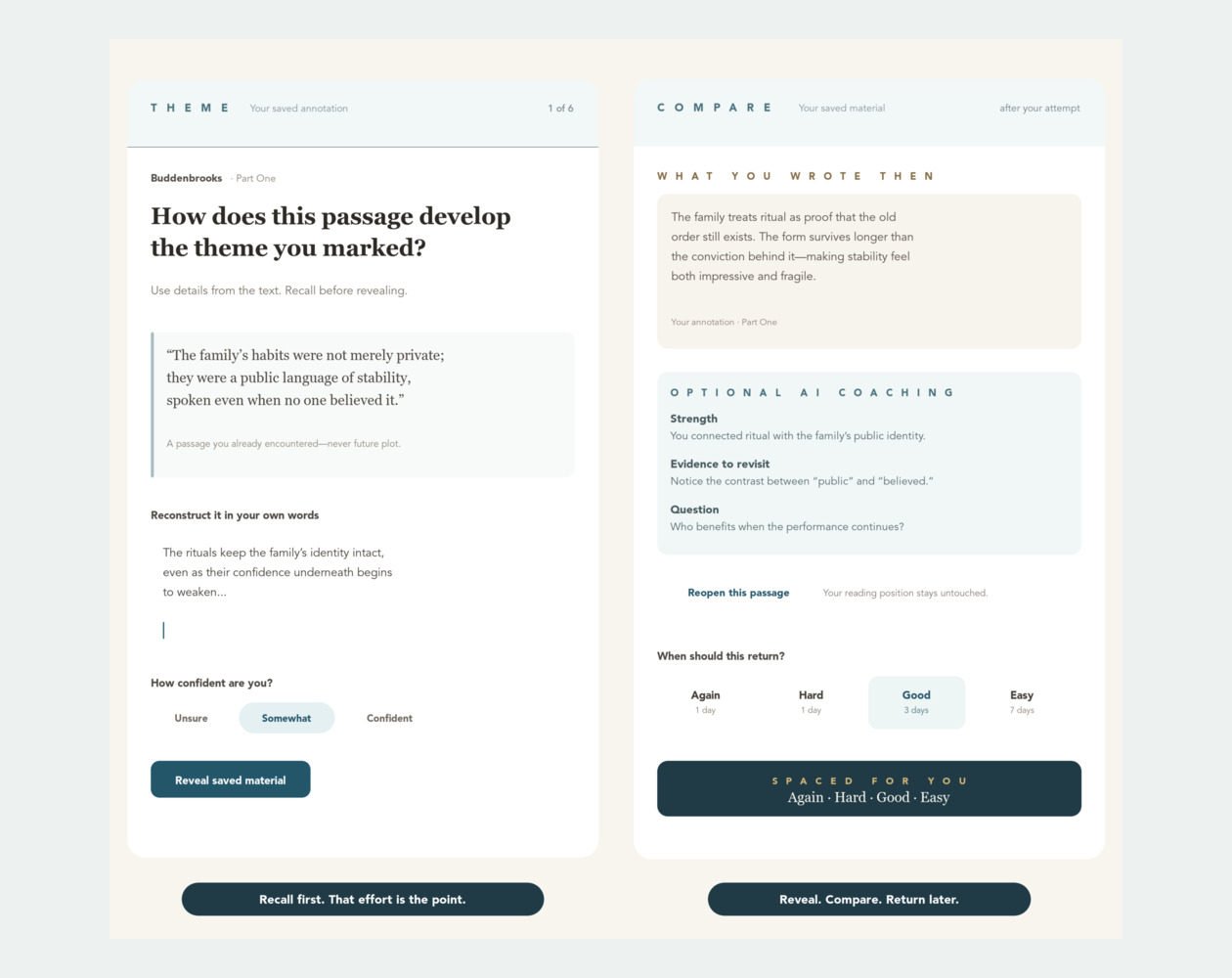
Today's Review does not begin by showing you everything again. It asks you to reconstruct an idea in your own words.
A review might ask what a marked term means in its passage, what you noticed in an annotation, or how a saved passage develops the theme you attached to it. You make an attempt, rate your confidence, and only then reveal the material you saved.
That order is deliberate. Research on retrieval practice shows that trying to bring knowledge to mind improves delayed retention more than simply studying it again. The effort is not friction around the learning—it is part of the learning.
After the reveal, you compare your answer with the saved or curated material and choose when it should return:
- Again for an idea that did not come back yet
- Hard when recall was incomplete
- Good when the essential idea survived
- Easy when it felt secure
BetterReads uses that judgment to space the next encounter. The first intervals are intentionally simple—roughly one, three, seven, and twenty-one days—then adapt as you review. This follows the broad evidence for distributed practice while leaving room for the fact that no single schedule is perfect for every reader or every idea.
Literature is not a multiple-choice test
Some things in a book are factual. A character's identity or the meaning of a historical term can be recalled more or less completely.
Interpretation is different. A note about ritual in Buddenbrooks is not a flashcard with one officially correct answer. You might return to the same passage and see a social performance, a family defense mechanism, or the beginning of a collapse that was not visible before.
Study preserves that openness. Interpretive prompts ask you to explain and reconnect rather than guess a hidden answer. Optional AI coaching appears after your attempt, not before it. It can point to textual evidence, identify a detail worth revisiting, or offer another question—but it does not pronounce your reading right or wrong.
That sequence matters. AI should support thinking, not remove the need to think.
Built to avoid spoilers
A review system for literature should never reward memory by revealing the future.
Automatic Study prompts come from passages and notes you have already encountered. Curated terms enter the queue only when you choose Learn. Coaching is grounded in the displayed passage and saved reference material, not later chapters.
When a prompt makes you want the full context, Reopen this passage returns you to its exact place in the book. Your normal reading position stays untouched, so reviewing an earlier scene does not move the bookmark for your next reading session.
Short enough to become a habit
Study is designed around a small daily queue, not an endless backlog. The dashboard tells you how many ideas are ready and gives a realistic time estimate. When the queue is done, it is done.
This keeps the relationship in the right order: Study exists to deepen reading, not to turn every book into a course. Browse the per-book archive whenever curiosity leads you there; use Today's Review when you want the important words and ideas to remain available later.
How to begin
You can open Study in three places:
- Tap Study while reading to go directly to the current book.
- Open a book's Study area to review its combined glossaries and annotations.
- Choose Study in the main navigation for Today's Review and your full library.
Your own glossary entries and meaningful annotations become reviewable automatically after a little spacing. For a companion glossary term, tap Learn to opt in.
Open your Study area and return to the words and ideas worth keeping.